Artists Space

Jonathan González:
Ways to Move: Black Insurgent Grammars

Book Launch
November 13, 2025, 7pm

Thursday, November 13
7pm
Free with RSVP. Please RSVP here.

Please join us for a book launch for Jonathan González’s Ways to Move: Black Insurgent Grammars, co-hosted by Ugly Duckling Presse. New York City choreographer, artist and writer Jonathan González will host a night of readings, screenings, and performances by Justin Allen, Rudy Gerson, Mario Gooden, Nile Harris, Marguerite Hemmings, Joselia Hughes, Benjamin Krusling, Shanzhai Lyric and Andrew Smyth, prompted by Ways to Move. The event will also feature a reading by González.
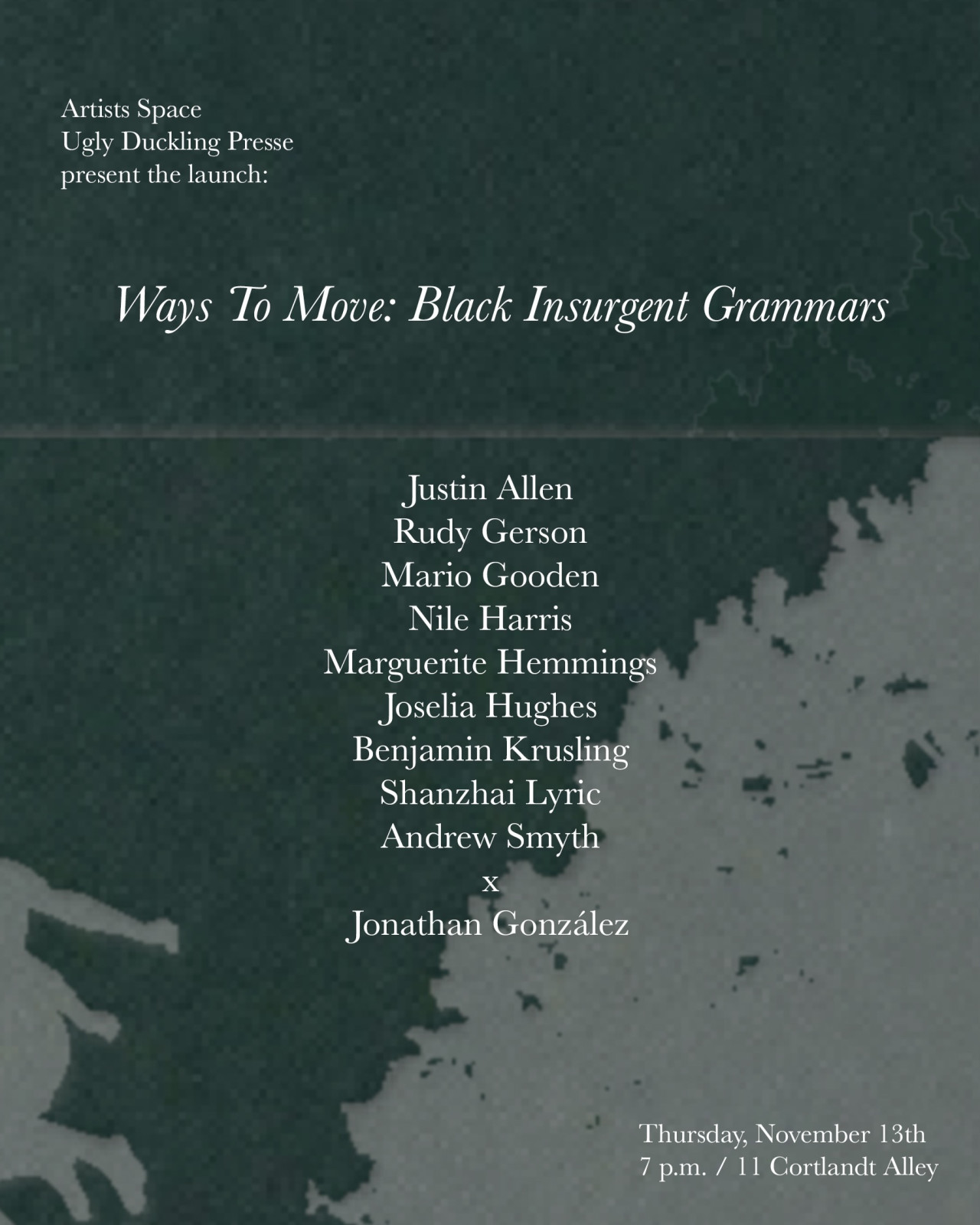
A green and white, textured background displays a silhouetted, leaping figure and the foliage of a tree. In the top left corner, "Artists Space / Ugly Duckling Presse / present the launch:" is written in white text. In the center "Ways to Move: Black Insurgent Grammars / Justin Allen / Rudy Gerson / Mario Gooden / Nile Harris / Marguerite Hemmings / Joselia Hughes / Benjamin Krusling / Shanzhai Lyric / Andrew Smyth / x / Jonathan González" appears in white text. In the bottom right corner "Thursday, November 13th / 7:00pm / 11 Cortlandt Alley" is written in white text.
Flyer for Ways to Move. November 13, 2025, Artists Space. [A green and white, textured background displays a silhouetted, leaping figure and the foliage of a tree. In the top left corner, "Artists Space / Ugly Duckling Presse / present the launch:" is written in white text. In the center "Ways to Move: Black Insurgent Grammars / Justin Allen / Rudy Gerson / Mario Gooden / Nile Harris / Marguerite Hemmings / Joselia Hughes / Benjamin Krusling / Shanzhai Lyric / Andrew Smyth / x / Jonathan González" appears in white text. In the bottom right corner "Thursday, November 13th / 7:00pm / 11 Cortlandt Alley" is written in white text.]

Moving between archival fragments, rehearsal notes, and speculative memory, Ways to Move: Black Insurgent Grammars traces the embodied frequencies and assembled states of Black life. González theorizes Blackness as a grammar, occupying the interstices of white colonial culture; Black movement and expression are both defined by and break down the hegemonic. Through a consideration of land, politics, magic, and movement, this hybrid work performs the perpetually unfinished task of resistance.

Praise for Ways to Move: Black Insurgent Grammars:

“González locates Black insurgent grammars in the very toxicity of racial capitalism, revealing how aesthetic practices operate through rather than against the particulate matter of environmental violence. His account moves fluidly between sixteenth-century Obeah trials and Lee Perry’s Black Ark studio, demonstrating how marronage has always been a question of frequency—tuning to oblique wavelengths that evade capture while remaining materially consequent. This is minoritarian revolution in motion: a vital resistance that passes through the apparatuses of domination, composing Black worlds in the space of a breath.” —Tavia Nyong’o, author of Black Apocalypse: Afrofuturism at the End of the World

“Guiding readers from the Caribbean to 1930s New York to contemporary Southern France and Greek isles, Ways to Move offers readers dazzling spatiotemporal styles of Black diasporic wayfinding. In domains way, way, way beyond the grasp of genre partitions, Jonathan González animates the written word ... Ways to Move is a text that will lavishly reward repeated engagement, leaving haunting aftershocks of a rigorous imagination comprising smudged traces of paths both ancestral and as-of-yet existent.” —Alexander Ghedi Weheliye, author of Feenin: R&B Music and the Materiality of BlackFem Voices and Technology

“[González’s] integrative project, operating through gestures of vignette and recollection—an anthology in the sense of ‘collection of flowers,’ a collation of the bloomed—emphasizes the somatics of presence and the social life of non-being, toward a vision where movement and gathering are their own theorists, bodies of practice that know what is to be done before we do, a knowledge registered as density in the air and vibration in the flesh.” —manuel arturo abreu, author of Incalculable Loss

Ways to Move is a book that knows it is possible to make a morsel of text deliciously dense with ideas. Here, both the recollected everyday moves of Black life and the dusty dates of dance history grow lush with texture, fragrance, and openings to new meaning." –Tara Willis, dancer, writer, Curator of Theater and Dance at EMPAC

Jonathan González is a choreographer and artist from New York. His practice explores the relations between culture, memory, architecture, and embodiment through performance, installation, and text.


Justin Allen works in music and sound, performance, visual art, and writing. He has been commissioned by The Chocolate Factory Theater, The Shed, and ISSUE Project Room, and received support from Franklin Furnace, Foundation for Contemporary Arts, and the Jerome Foundation. In 2022, he released a four-song EP, Ekphrastic Punk, with his band Black Boots. In the fall of 2024, he released his first book, Language Arts, published by Wendy’s Subway.


Rudy Gerson is an artist and educator exploring how groups and collectivity form beyond and against institutional frameworks. Through subjects like sports, nationalism, and dance, works take up a mythic lens in arenas of pleasure, violence, and devotion. He loves Jonathan too.


Mario Gooden is Director of the MArch Program at Columbia GSAPP. Gooden is also the Director of Mario Gooden Studio: Architecture + Design, a transdisciplinary practice dedicated to the design and exploration of architecture and its relationships to culture and knowledge. His practice merges architectural design with landscape, urbanism, history, cultural production, and performance.


Nile Harris is a performer and director of live art. He has done a few things and hopes to do a few more, God willing.


Marguerite Hemmings is a mover, choreographer, educator, performer, and social practitioner. They research the subversive role of dance and music throughout the African Diaspora and channel this research through performance, body, text, social/public media, and moving image.


Joselia Hughes is an Afro-Caribbean descended writer, access worker, artist, and educator based in the Bronx. She lives with Sickle Cell Disease. Joselia’s work interrogates debility, narrative flux, (de)capacitation, speculative near-presents, archetypes of The Fool, and rhetorics of access. Joselia’s poetry has been nominated for a Best of Net. Her writing has been published in Apogee Journal, Massachusetts Review, The Poetry Project, Split This Rock, Blackflash Magazine, and elsewhere.


Benjamin Krusling works in sound, text, and moving image. He is the author of the collection Glaring. Fear of God Essentials is forthcoming from Nightboat in 2027.


Shanzhai Lyric is a roving poetic research unit inspired by the experimental language of shanzhai (counterfeit) garments. Using publication, installation, archive, and poetry-talk, they investigate the poetics and politics of the bootleg. In 2020, Shanzhai Lyric founded fictional office entity Canal Street Research Association to gather ephemeral histories, map local lore, and trace the flows and fissures of capital.


Andrew Smyth is a poet who lives in New York. He is currently a PhD candidate in English at the University of Pennsylvania.

Artists Space Venue is generously supported by Stephen Cheng, Allan Schwartzman, and David Zwirner.